Archive for the ‘Sudoku’ Category:

Championship Chatter – Hold Tight

Two more from the US Sudoku Qualifying Test in May — both are styles I’ve constructed a lot of in the past and will likely continue to construct a lot of in the future as they are both pretty simple variations that add more properties of the numbers into the logic of sudoku and enrich the solving experience.

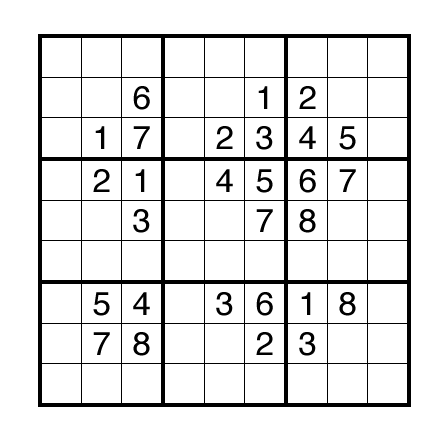
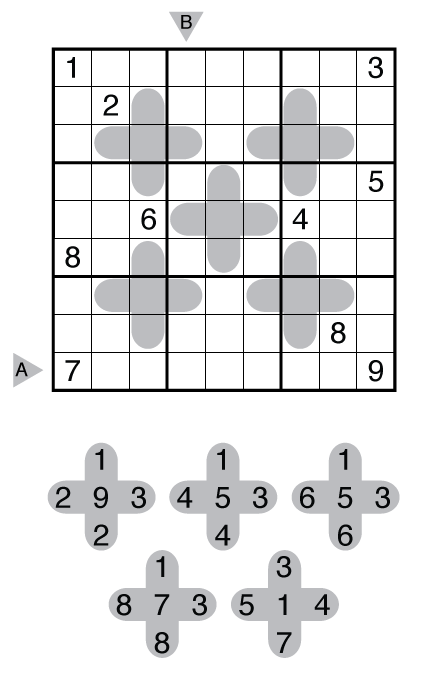
I went for a lot of less common symmetry types with this test (diagonal or mirror symmetries instead of 180 degree rotational) and both of these themes showcase one of those less common types. With Tight Fit, the diagonal symmetry works well with the added slashes forming their own diagonals parallel to the mirror plane. The solve was meant to fairly easy, but the sparsity of starting digits here actually leads to a rather large cycle to place two of the highest digits remaining towards the end of the puzzle. This trait pulled it towards the top of my pile of Tight Fit to include here.

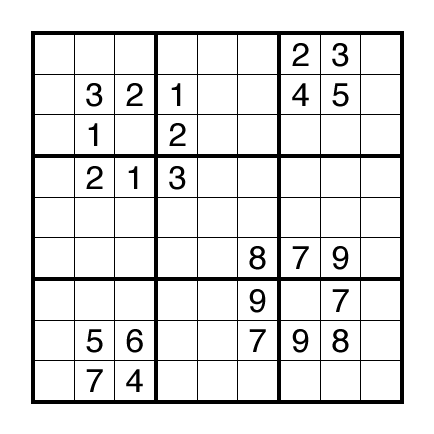
For the Consecutive Sudoku, I’ve been doing a fair bit of half consecutive/half non-consecutive exploration recently (such as this earlier GMPuzzles one). And I’ve played with 2×2 box shapes with consecutive bars before too, such as here. Well, it turns out that there are no puzzles possible that have just the 2×2 box shapes in opposite corners as in the second linked puzzle without additional bars elsewhere. But there are a whopping 4 possible solutions with the repeated top boxes and no other bars as here (and 2 of those 4 are trivial copies from a 1-9 to 9-1 swap). It was from that small set of potential solutions that I crafted this puzzle. Using a given presentation that evokes the same kind of bars as up top seemed best and gave the solving properties I wanted. But if you’d like an extra hard challenge different from this one, put a single 1 in the lower-left corner and try to solve from there. As I’ve discussed before, the non-consecutive constraint is really powerful and constraining in ways you wouldn’t expect but it always needs some hands-on work to cultivate a fun and approachable puzzle.

Both of these puzzle are probably on the easier end for this test, but both are good representations of the new logic that arises from the variation. As “extras” from the first Grandmaster Puzzles construction cycle, it seems fitting to get them both up here now.
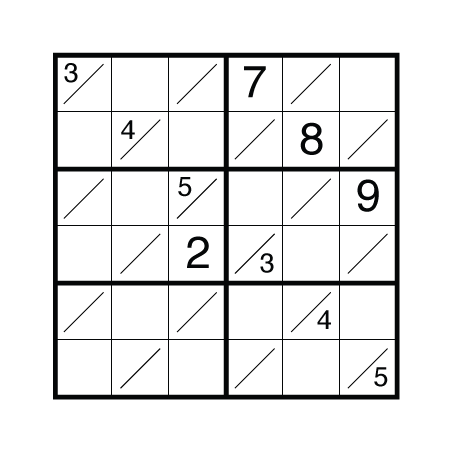
Sudoku by Thomas Snyder

PDF

or solve online (using our beta test of Penpa-Edit tools; use tab to alternate between Sudoku = big entries and Number candidate = small entries in the corners of cells.)

Theme: Diagonal Series

Rules: Standard Tight Fit Sudoku rules. Range is 1-9.

Answer String: For the USSQT, the answer strings were a set of rows/columns encountered late in the puzzle. For this week, you can just hit the solved button on an honor system if you think you’ve solved it.

Solution: PDF
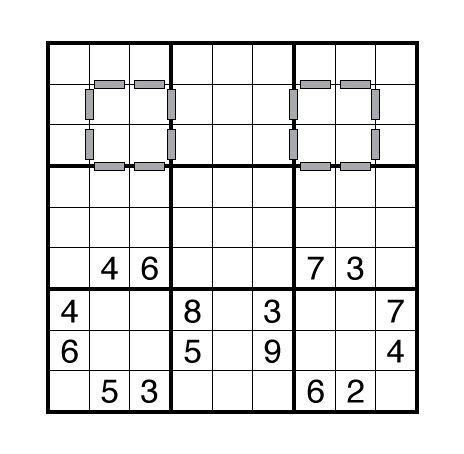
Sudoku by Thomas Snyder

PDF

or solve online (using our beta test of Penpa-Edit tools)

Theme: Boxes of Two Sorts

Rules: Standard Consecutive Sudoku rules.

Answer String: For the USSQT, the answer strings were a set of rows/columns encountered late in the puzzle. For this week, you can just hit the solved button on an honor system if you think you’ve solved it.

Solution: PDF
Championship Chatter – Simply Classic

The Sudoku Grand Prix (GP) has certainly now shown a variety of test styles after the creative but unorthodox Turkish test this past weekend. I’m still not sure exactly what the GP is trying to be, and I have no idea what the “playoff” in Beijing will look like (does anyone know anything about the rules or puzzle designers?), but the list of 10 competitors to qualify is getting much clearer now. Quite incredible to have a different winner for each event so far.

Our test, like some others in the GP such as the UK test, had a pretty clear goal to have a lot of elegantly constructed sudoku in pretty simple styles to test basic sudoku skills. All our puzzles had fair, logical solution paths, and we expected many solvers would finish. And as I still think of this as a US Sudoku Qualifier first, and a GP contest piece second, I was glad we got two of the qualifying Americans to submit all of the answers even if one had a mistake. While this is now quite belated, congrats to Jason Zuffranieri for his US victory and to Bastien Vial-Jaime for the overall victory.

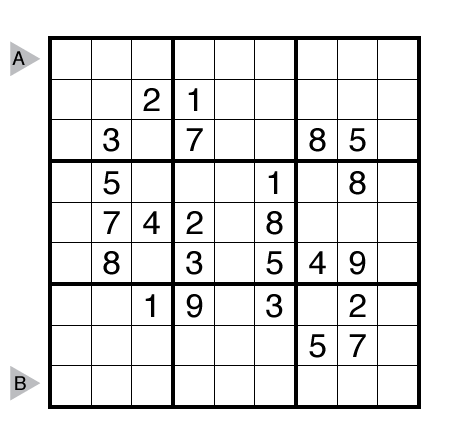
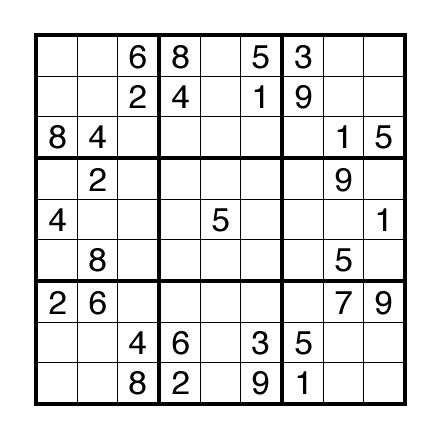
Here is the second pair of classic sudoku that appeared on that contest.

Sudoku by Thomas Snyder

PDF

or solve online (using our beta test of Penpa-Edit tools)

Sudoku by Thomas Snyder

PDF

or solve online (using our beta test of Penpa-Edit tools)

Themes: Both geometric and logical

Rules: Standard Sudoku rules.

Answer String: For the USSQT, the answer strings were a set of rows/columns encountered late in the puzzle. For this week, you can just hit the solved button on an honor system if you think you’ve solved it.

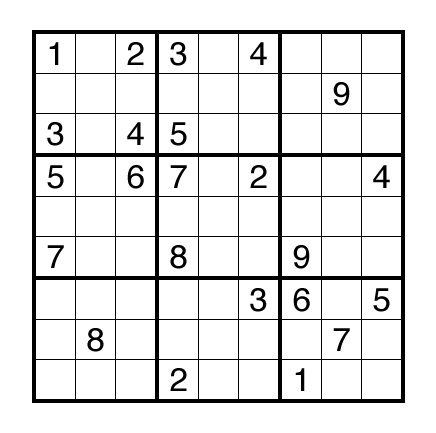
Design Notes (highlight to view): The third classic sudoku (and first here) was built around an even versus odd theme and recognizing this unusual partitioning of the digits will be key to making fast progress. A bunch of singles (either naked or hidden) can be found based on parity around the middle sections which finally breaks through to the final solution. The fourth classic sudoku (and second here) was constructed to have an early and pretty clear single sticking point aspect to it. The geometry suggests something should be present in the almost full rows or columns. If solvers focus on those most constrained positions in the first column, they will find a naked pair [89] that gets the whole solve going. While none of these classic puzzles required extremely difficult techniques, keeping the solving paths somewhat tight at the very start makes them good competition challenges in my mind.

Solutions: PDF and PDF

(Older) Championship Chatter – Sudokus and Such

While scheduling the month of June for the site, and considering the potential for some likely downtime or errors while changing web hosts, I budgeted two weeks for recent US championship puzzle discussion. For this week, I’ve planned to cover the US Sudoku Qualifying Test (also the sixth leg of the Sudoku Grand Prix). If you are desperate for new puzzles, those will arrive next Monday at their usual time. But there may be some new challenges revealed throughout this week during the discussion of these creative sudoku.

I figured I’d give a general overview of our design process at the start. As with past years, we (Nick Baxter, Wei-Hwa Huang, and myself) had planned a two-part championship with Classics and near classic variations for the first part, and mostly new or less common styles for the second part. Some of this has been to gauge relative solving capabilities on the challenges that might appear at a WSC, and some of this has been for our own sanity checking of potential competitors. There are more web-accessible sudoku solving tools that can handle “part 1” puzzles and some unbelievable times have been posted there in the past. But less familiar or original styles in “part 2” will challenge anyone solving with certain types of assistance. After the 2009 experiences in Philadelphia at our last live national championship, we know to be extra cautious.

While having two parts was the original plan, the requirements of the Grand Prix changed our design mid-stream and a single big round was used instead. So solvers got 2.5 straight hours of solving to test their mettle. But you can see that the ordering of the puzzles still naturally splits the first ten from the last ten and perhaps many solvers found themselves focusing on just the first part instead of the other.

We like having a mix of puzzles but also a fair number of classic sudoku since a sudoku championship should certainly test the fundamentals. I wrote all 4 of our classic puzzles, each somewhat noteworthy in its own way. Their numbering was maintained in my “construction order”, as testing revealed their mean solve times were within a minute of each other and they would all receive the same point values on the test. I believe only solvers with a very broad skill set would have a uniform performance on the entire set. But just as different test-solvers reported being tripped up by different puzzles, competitors reported the same thing with #2 and #4 seeming to be outliers. I wonder what your experiences were?

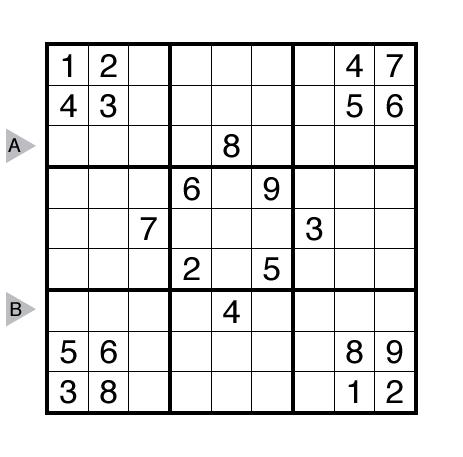
I’m posting the first two classic puzzles below, with design spoilers concealed after each puzzle. The next two classics will follow tomorrow.

Sudoku by Thomas Snyder

PDF

or solve online (using our beta test of Penpa-Edit tools)

Sudoku by Thomas Snyder

PDF

or solve online (using our beta test of Penpa-Edit tools)

Themes: Both geometric and logical

Rules: Standard Sudoku rules.

Answer String: For the USSQT, the answer strings were a set of rows/columns encountered late in the puzzle. For this week, you can just hit the solved button on an honor system if you think you’ve solved it.

Design Notes (highlight to view): The first puzzle was designed around a low/middle/high separation and has large squares made out of 1-3 and 7-9 only that provide some symmetry along the solve. For example, consider the 1 in the upper-right corner and the 9 in the lower-left corner which come from looking horizontally, followed by either 79 or 12 pairs to finish those border columns from looking vertically each allowing the last two numbers in the corner regions to be identified. This is probably the easiest of the four classic puzzles but not by much. The second puzzle was designed to require good use of pointing pairs, particularly in the upper-left boxes, involving the “8” and “9” that are lone digits. A relay of these pointing pairs through two boxes should place the first 8s and 9s that cascade to give several other digits.

Solutions: PDF and PDF

Sunday Surprise #6 – US Championship

I had not intended to have a repeat author for a Sunday Surprise so soon, but Craig Kasper sent along a really nice surprise sudoku to mark the US National Championship we’ve been focusing our attention on all weekend. See if you can find your way through to the very end.

Surprise Puzzle by Craig Kasper

PDF

or solve online (using our beta test of Penpa-Edit tools)

Theme: That US national championship happening this weekend; speaking of which, congratulations to the top finishers at the US Puzzle Championship, whomever you turn out to be.

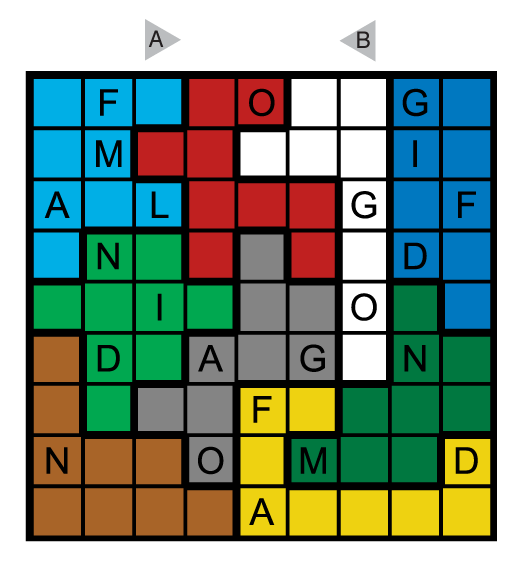
Rules: Standard Sudoku rules. Also, the regions are irregularly shaped; instead of numbers, use the letters in “I’D GOLF, MAN” once in each row, column, and region.

Answer String: Enter the letters in the third column, from top to bottom, followed by the letters in the seventh column, from top to bottom. USE CAPITAL LETTERS.

Solution: PDF

Dr. Sudoku Prescribes #111 – Shape Sudoku

Sudoku by Thomas Snyder

PDF

or solve online (using our beta test of Penpa-Edit tools; use tab to alternate between Sudoku number entry mode and a shading mode to manage the shape inventory.)

This is a “Franken-Friday” puzzle variation.

Theme: Plus Signs

Rules: Standard Shape Sudoku rules.

Answer String: Enter the 9th row from left to right, followed by a comma, followed by the 4th column from top to bottom.

Time Standards (highlight to view): Grandmaster = 7:00, Master = 15:00, Expert = 30:00

Solution: PDF

Dr. Sudoku Prescribes #109 – Sudoku

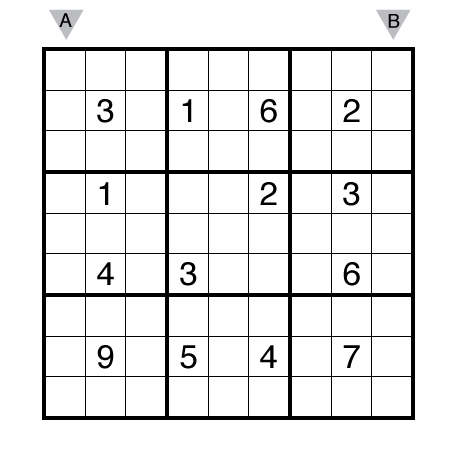
Sudoku by Thomas Snyder

PDF

or solve online (using our beta test of Penpa-Edit tools)

Theme: 6/6

Rules: Standard Sudoku rules.

Answer String: Enter the 1st row from left to right, followed by a comma, followed by the 9th row from left to right.

Time Standards (highlight to view): Grandmaster = 2:30, Master = 3:45, Expert = 7:30

Solution: PDF

Author’s Note (spoilers): While there are no given sixes in the grid, did you notice that it is very easy to put two sixes into two specific spots?. Follow this link for other classic Sudoku. If you are new to this puzzle type, here are our easiest Sudoku to get started on. More classic Sudoku puzzles can be found in The Art of Sudoku, The Art of Sudoku 2 and in our beginner-friendly collection Intro to GMPuzzles by Serkan Yürekli.

Dr. Sudoku Prescribes #103 – Sudoku

Sudoku by Thomas Snyder

PDF

or solve online (using our beta test of Penpa-Edit tools)

Theme: Five Squares

Rules: Standard Sudoku rules.

Answer String: Enter the 3rd row from left to right, followed by a comma, followed by the 7th row from left to right.

Time Standards (highlight to view): Grandmaster = 2:30, Master = 4:00, Expert = 8:00

Solution: PDF

Note: Follow this link for other classic Sudoku. If you are new to this puzzle type, here are our easiest Sudoku to get started on. More classic Sudoku puzzles can be found in The Art of Sudoku, The Art of Sudoku 2 and in our beginner-friendly collection Intro to GMPuzzles by Serkan Yürekli.

Dr. Sudoku Prescribes #98 – Sudoku (Skyscraper)

Sudoku (Skyscraper) by Thomas Snyder

PDF

or solve online (using our beta test of Penpa-Edit tools)

This is a “Twisted Tuesday” puzzle variation.

Theme: Big City

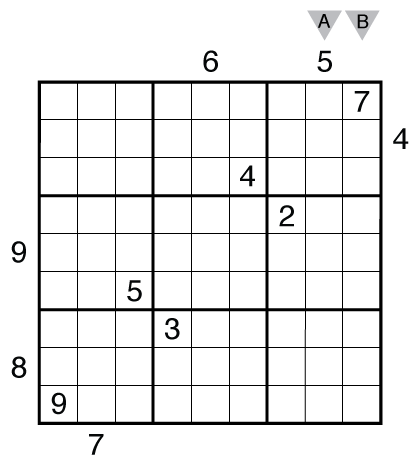
Rules: Standard Sudoku rules. Also, standard Skyscrapers rules.

Answer String: Enter the 8th column from top to bottom, followed by a comma, followed by the 9th column from top to bottom.

Time Standards (highlight to view): Grandmaster = 4:00, Master = 6:30, Expert = 13:00

Solution: PDF

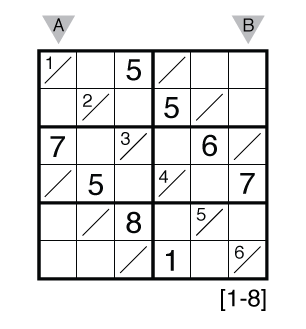
From the Foxger’s Den #17: Tight Fit Sudoku

Tight Fit Sudoku by Grant Fikes

PDF

or solve online (using our beta test of Penpa-Edit tools; use tab to alternate between Sudoku = big entries and Number candidate = small entries in the corners of cells.)

Theme: Diagonals

Rules: Standard Tight Fit Sudoku rules. Range is 1-8.

Answer String: Enter the 1st column from top to bottom, followed by a comma, followed by the 6th column from top to bottom. (Note: for the tight fit cells, enter the top before the bottom as would be normal for the read order.)

Time Standards (highlight to view): Grandmaster = 0:50, Master = 1:15, Expert = 2:30

Solution: PDF

Note: Follow this link for other Tight Fit Sudoku puzzles on this website. If you are new to this puzzle type, here are our easiest Tight Fit Sudoku to get started on. More Tight Fit Sudoku can be found in our beginner-friendly collection Intro to GMPuzzles by Serkan Yürekli and in The Art of Sudoku 2.

Dr. Sudoku Prescribes #97 – Non-Consecutive Sudoku

Non-consecutive Sudoku by Thomas Snyder

PDF

or solve online (using our beta test of Penpa-Edit tools)

Theme: Mostly themeless

Rules: Standard Consecutive Sudoku rules. Since there are no bars in this grid, this should be considered a Non-Consecutive Sudoku.

Answer String: Enter the 1st column from top to bottom, followed by a comma, followed by the 9th column from top to bottom.

Time Standards (highlight to view): Grandmaster = 6:30, Master = 11:00, Expert = 22:00

Solution: PDF