Visit our store
Join our Discord
Tip Jar
About
Posts by Category
- Atypical (53)
- Sudoku (904)
- Just One Cell Sudoku (42)
- Classic Sudoku (220)
- Arrow Sudoku (66)
- Thermo-Sudoku (62)
- Tight Fit Sudoku (50)
- Even/Odd Sudoku (45)
- Consecutive Pairs Sudoku (37)
- Killer Sudoku (39)
- Isodoku (16)
- Shape Sudoku (17)
- Consecutive Sudoku (14)
- Outside Sudoku (13)
- Sudo-Kurve (7)
- Battleship Sudoku (7)
- Tile Sudoku (5)
- Deficit/Surplus Sudoku (6)
- Other Sudoku (271)
- Number Placement (501)
- TomTom (150)
- Skyscrapers (131)
- Kakuro (106)
- Japanese Sums (30)
- Math Path (16)
- Tango (13)
- Other Number Placement (58)
- Object Placement (476)
- Star Battle (166)
- Battleships (109)
- Statue Park (87)
- Minesweeper (65)
- Pentopia (29)
- Other Object Placement (36)
- Shading (665)
- Tapa (203)
- LITS (110)
- Cross the Streams (95)
- Nurikabe (84)
- Nanro (68)
- Kurotto (51)
- Aqre (28)
- Other Shading (43)
- Region Division (567)
- Fillomino (158)
- Cave (131)
- Pentominous (109)
- Araf (63)
- Spiral Galaxies (31)
- Snake Pit (29)
- Kuromasu (16)
- Other Region Division (32)
- Loop/Path (600)
- Masyu (121)
- Slitherlink (121)
- Yajilin (114)
- Castle Wall (66)
- Balance Loop (51)
- Snake (43)
- Tapa-Like Loop (33)
- Round Trip (18)
- Other Loop/Path (61)
- Other Puzzles (65)
- Surprise Puzzles (21)
- Word Puzzle (20)
- Puzzle Hunt (21)
- Word Search (4)
- Other Posts (638)
- Best Of … (63)
- Solving Tips and Tricks (17)
- News (116)
- Schedule (420)
- Contests (18)
- Competition Discussion (18)
- Puzzle (3,834)
- Variation (1,150)
- Subscription Puzzles (805)
- Reposts (60)
- Uncategorized (4)
Posts by Author
Posts by Difficulty
Archives

This work is licensed under a Creative Commons Attribution-NonCommercial-NoDerivs 3.0 Unported License.
Statue Park by Palmer Mebane
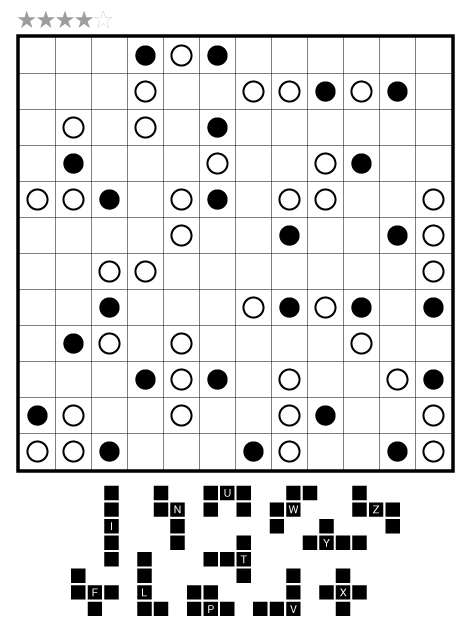
or solve online (using our beta test of Penpa-Edit tools)
Theme: Second Generation
Author/Opus: This is the 56th puzzle from our contributing puzzlemaster Palmer Mebane.
Rules: Standard Statue Park rules. This puzzle uses a standard pentomino set.
Difficulty: 4 stars
Time Standards (highlight to view): Grandmaster = 6:00, Master = 10:30, Expert = 21:00
Solution: PDF; a solution video is also available here.
Note: Follow this link for other classic Statue Park and this link for Statue Park variations. If you are new to this puzzle type, here are our easiest Statue Parks to get started on. More Statue Park puzzles can be found in the ebook Statue Park by Murat Can Tonta.
Pentominous (Star Battle) by Grant Fikes
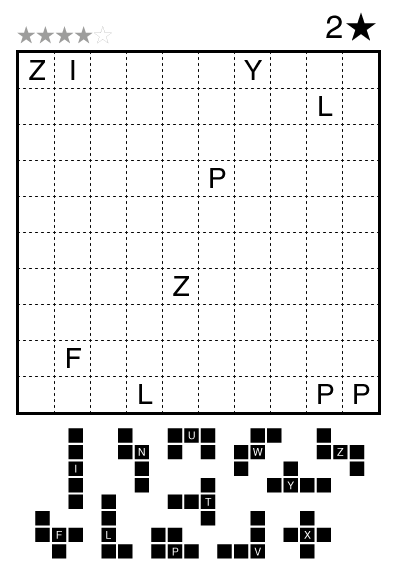
or solve online (using our beta test of Penpa-Edit tools; use tab to alternate between a composite mode for line/edge drawing, a letter entry mode, and shading / shape entry modes depending on how you want to mark the stars.)
Author/Opus: This is the 360th puzzle from our contributing puzzlemaster Grant Fikes.
Rules: Combination of Pentominous and Star Battle. Place stars into some cells so that there are two stars in each row and column; no two stars can touch, even diagonally. Then divide the rest of the grid into 16 regions each containing 5 cells. Regions with the same shape (including rotations/reflections) cannot share an edge. A cell with a letter in it must be part of the pentomino shape normally associated with that letter; an inventory of pentominoes is given below the puzzle.
Difficulty: 4 stars
Time Standards (highlight to view): Grandmaster = 5:30, Master = 10:15, Expert = 20:30
Solution: PDF; a solution video is also available here.
Note: Follow this link for other Pentominous puzzles. If you are new to this puzzle type, here are our easiest Pentominous to get started on. More Pentominous puzzles can be found in the Plenty o’ Pentominous series by Grant Fikes and Murat Can Tonta and in our beginner-friendly collection Intro to GMPuzzles by Serkan Yürekli.
Pentominous (Cipher) by Takeya Saikachi
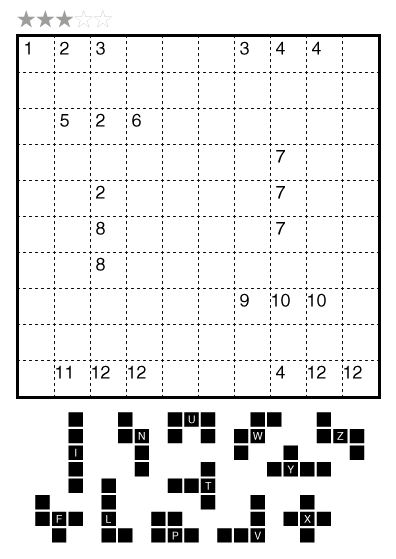
or solve online (using our beta test of Penpa-Edit tools; use tab to alternate between a composite mode for line/edge drawing and a letter entry mode.)
Theme: Triplets
Author/Opus: This is the 11th puzzle from guest contributor Takeya Saikachi.
Rules: Variation of Pentominous rules. Divide the grid into 20 pentominoes so that no two pentominoes of the same shape (including rotations/reflections) share an edge. Each number in this grid represents a clue for a different letter/pentomino as in a regular Pentominous puzzle; all instances of a number must represent the same letter. An inventory of possible pentominoes is given below the puzzle.
Difficulty: 3 stars
Time Standards (highlight to view): Grandmaster = 3:15, Master = 5:00, Expert = 10:00
Solution: PDF; a solution video is also available here.
Note: Follow this link for other Pentominous puzzles. If you are new to this puzzle type, here are our easiest Pentominous to get started on. More Pentominous puzzles can be found in the Plenty o’ Pentominous series by Grant Fikes and Murat Can Tonta and in our beginner-friendly collection Intro to GMPuzzles by Serkan Yürekli.
Pentominous (Borders) by Serkan Yürekli
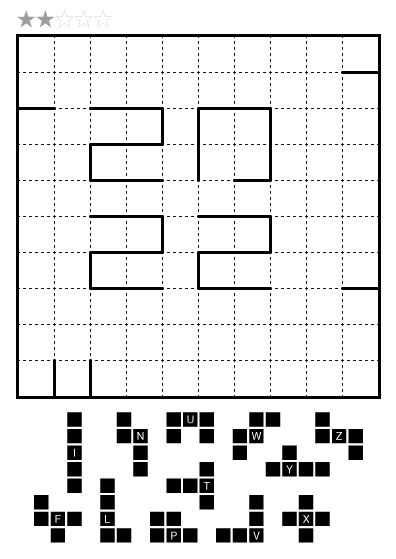
or solve online (using our beta test of Penpa-Edit tools; use tab to alternate between a composite mode for line/edge drawing and a letter entry mode.)
Theme: 2022
Author/Opus: This is the 346th puzzle from our managing editor Serkan Yürekli.
Rules: Variation of Pentominous rules. Some borders between pentominoes are already drawn.
Difficulty: 2 stars
Time Standards (highlight to view): Grandmaster = 1:45, Master = 2:30, Expert = 5:00
Solution: PDF; a solution video is also available here.
Note: Follow this link for other Pentominous puzzles. If you are new to this puzzle type, here are our easiest Pentominous to get started on. More Pentominous puzzles can be found in the Plenty o’ Pentominous series by Grant Fikes and Murat Can Tonta and in our beginner-friendly collection Intro to GMPuzzles by Serkan Yürekli.
Pentominonogram by Elyot Grant
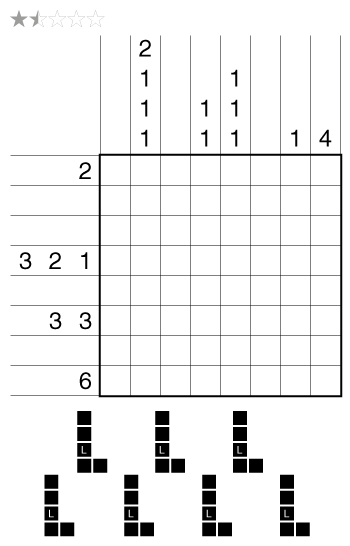
or solve online (using our beta test of Penpa-Edit tools).
Theme: 7-L
Author/Opus: This is the 4th puzzle from guest contributor Elyot Grant.
Rules: Shade some cells so that the numbers outside the grid indicate the groups of consecutive black cells which are in that row/column in order, either from left to right or from top to bottom. There must be at least one white cell between any consecutive shaded groups. Rows and columns without outside clues can have any pattern of shaded and unshaded cells. Also, all the shaded cells must be able to be split into the seven given pentomino shapes. Pentominoes may be flipped and/or rotated.
Difficulty: 1.5 stars
Time Standards (highlight to view): Grandmaster = 1:00, Master = 2:00, Expert = 4:00
Solution: PDF; a solution video is also available here.
Note: Follow this link for other less common Shading puzzles.
Minesweeper (Pentomino) by Murat Can Tonta
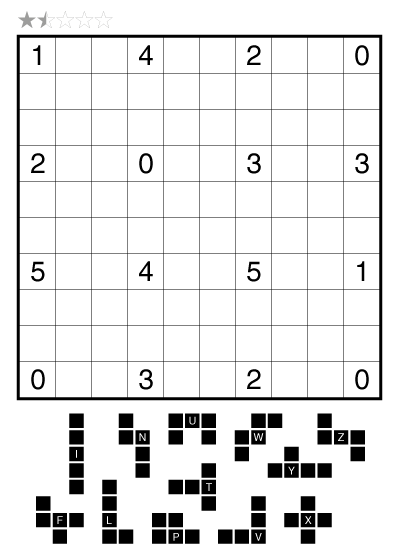
or solve online (using our beta test of Penpa-Edit tools).
Theme: 4×4×4
Author/Opus: This is the 216th puzzle from our contributing puzzlemaster Murat Can Tonta.
Rules: Place some of the given pentominoes into the grid, rotations and reflections allowed, but without repeats of any shape. Pentominoes cannot cover the numbered cells, and different pentomino shapes cannot be placed in adjacent cells that share an edge or corner. Numbered cells indicate how many of the surrounding cells (including diagonally adjacent cells) contain parts of the pentominoes.
Difficulty: 1.5 stars
Time Standards (highlight to view): Grandmaster = 1:00, Master = 2:00, Expert = 4:00
Solution: PDF; a solution video is also available here.
Note: Follow this link for classic Minesweeper puzzles on this website and this link for variations on Minesweeper puzzles. If you are new to this puzzle type, here are our easiest Minesweeper Puzzles to get started on. More Minesweeper puzzles can be found in The Art of Puzzles 2.
Sunday Update and Solutions
Our past week of Nanro puzzles is collected in this PDF and the solutions are in this PDF. Also, we just finished digitizing all of our Nanro puzzles for Penpa-Edit solving so check out our archive.
The daily solution videos are on the posts and linked below:
We’re reaching the end of 2021 with two more weeks of puzzles. This next week features six different puzzles involving Pentominoes.
Nanro Loop by Bryce Herdt
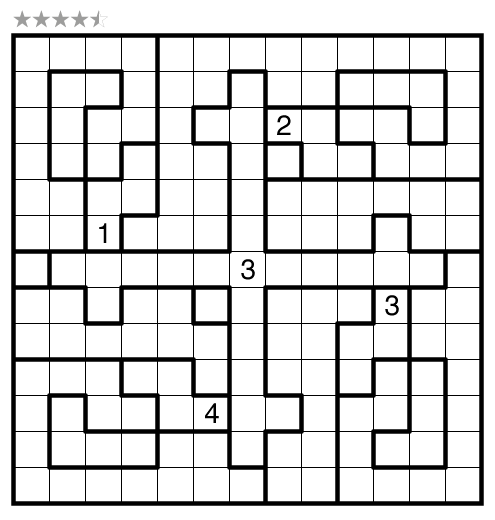
or solve online (using our beta test of Penpa-Edit tools; use the tab key to alternate between shading, number entry, and composite loop drawing modes)
Theme: Clockwise
Author/Opus: This is the 21st puzzle from guest contributor Bryce Herdt.
Rules: Variation of Nanro rules. Label some cells with numbers to form a single non-intersecting loop; no 2×2 group of cells may be fully labeled, but the loop may touch itself orthogonally or diagonally. The region boundaries divide the loop into segments, and each region must have at least one segment. Numbers denote the length in cells of each segment within a region; all numbers in a region must be the same. When two numbers from different segments are orthogonally adjacent, the numbers must be different. (Consequently, segments in the same region must not share an edge.)
Also see this example:
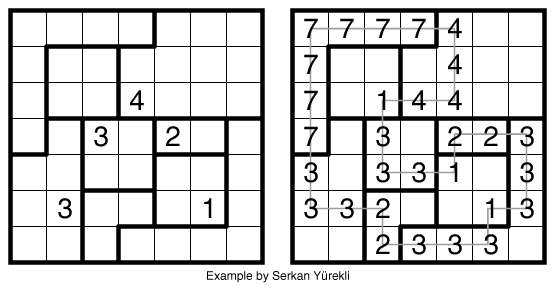
Difficulty: 4.5 stars
Time Standards (highlight to view): Grandmaster = 5:00, Master = 12:30, Expert = 25:00
Solution: PDF; a solution video is also available here.
Note: Follow this link for Nanro puzzles on this website and this link for variations on Nanro puzzles. If you are new to this puzzle type, here are our easiest Nanro Puzzles to get started on. More Nanro puzzles can be found in A Number o’ Nanro by Prasanna Seshadri.
Nanro by Palmer Mebane
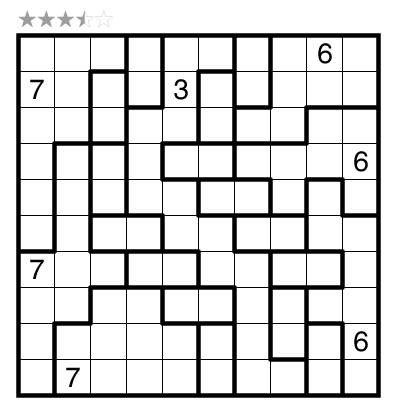
or solve online (using our beta test of Penpa-Edit tools; use the tab key to alternate between shading and number entry modes)
Theme: Six Afraid of Seven
Author/Opus: This is the 55th puzzle from our contributing puzzlemaster Palmer Mebane.
Rules: Standard Nanro rules.
Difficulty: 3.5 stars
Time Standards (highlight to view): Grandmaster = 3:45, Master = 7:30, Expert = 15:00
Solution: PDF; a solution video is also available here.
Note: Follow this link for Nanro puzzles on this website and this link for variations on Nanro puzzles. If you are new to this puzzle type, here are our easiest Nanro Puzzles to get started on. More Nanro puzzles can be found in A Number o’ Nanro by Prasanna Seshadri.