Archive for the ‘Variation’ Category:

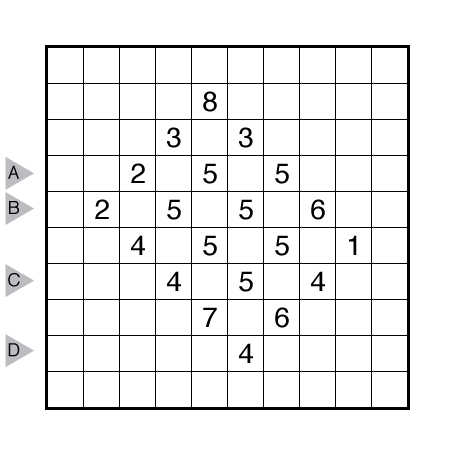
Double Spiral Galaxies by Carl Worth
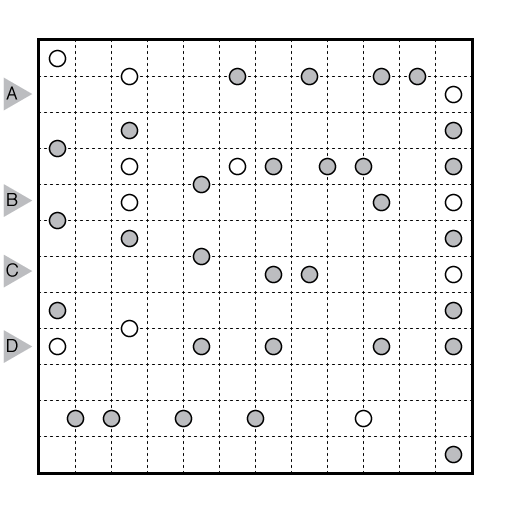
Spiral Galaxies by Carl Worth

PDF

or solve online (using our beta test of Penpa-Edit tools; use tab to alternate between a composite mode for line/edge drawing and a shading mode.)

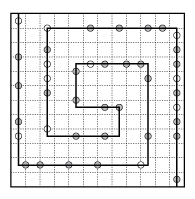
Theme: Double Spiral Galaxy (the pattern of galaxies is a double spiral as shown here)
Author/Opus: This is the 25th puzzle from our contributing puzzlemaster Carl Worth.

Rules: Variation of Spiral Galaxies. In addition to the standard rules, some circles are shaded gray and must belong to galaxies containing two gray circles, not one, with the circles in rotationally symmetric spots for those galaxies.
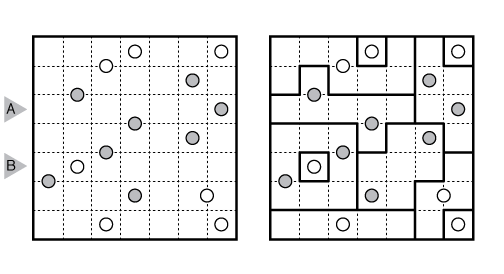
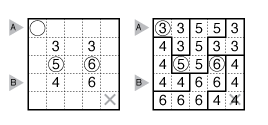
Double Spiral Galaxies Example by Thomas Snyder

Answer String: Enter the number of cells in each connected group (between bold lines) in the marked rows. Separate each row’s entry from the next with a comma. The example has the answer “52,11131”.

Time Standards (highlight to view): Grandmaster = 10:30, Master = 17:00, Expert = 34:00

Solution: PDF

Note: Follow this link for classic Spiral Galaxies puzzles on this website and this link for variations on Spiral Galaxies puzzles. If you are new to this puzzle type, here are our easiest Spiral Galaxies Puzzles to get started on. More Spiral Galaxies puzzles will soon be found in The Art of Puzzles 2.
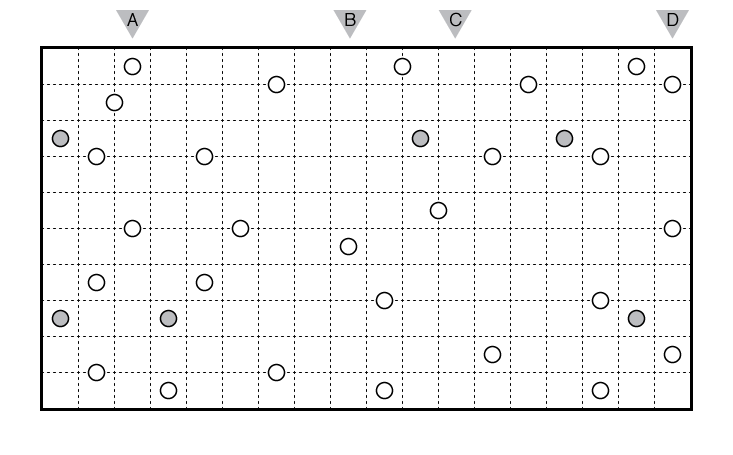
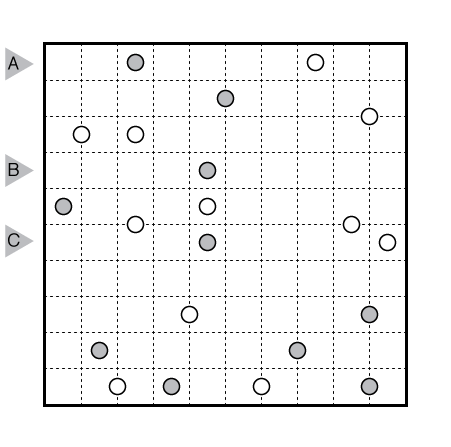
Double Spiral Galaxies by John Bulten

Spiral Galaxies by John Bulten

(view directly for a larger image)

PDF

or solve online (using our beta test of Penpa-Edit tools; use tab to alternate between a composite mode for line/edge drawing and a shading mode.)

Theme: Astronomical Clock

Author/Opus: This is the 26th puzzle from our contributing puzzlemaster John Bulten.

Rules: Variation of Spiral Galaxies. In addition to the standard rules, some circles are shaded gray and must belong to galaxies containing two gray circles, not one, with the circles in rotationally symmetric spots for those galaxies.

Double Spiral Galaxies Example by Thomas Snyder

Answer String: Enter the number of cells in each connected group (between bold lines) in the marked columns. Separate each column’s entry from the next with a comma. The example (using rows) has the answer “52,11131”.

Time Standards (highlight to view): Grandmaster = 6:15, Master = 10:15, Expert = 20:30

Solution: PDF

Note: Follow this link for classic Spiral Galaxies puzzles on this website and this link for variations on Spiral Galaxies puzzles. If you are new to this puzzle type, here are our easiest Spiral Galaxies Puzzles to get started on. More Spiral Galaxies puzzles will soon be found in The Art of Puzzles 2.
Double Spiral Galaxies by Serkan Yürekli

Spiral Galaxies by Serkan Yürekli

PDF

or solve online (using our beta test of Penpa-Edit tools; use tab to alternate between a composite mode for line/edge drawing and a shading mode.)

Theme: Logical

Author/Opus: This is the 160th puzzle from our contributing puzzlemaster Serkan Yürekli.

Rules: Variation of Spiral Galaxies. In addition to the standard rules, some circles are shaded gray and must belong to galaxies containing two gray circles, not one, with the circles in rotationally symmetric spots for those galaxies.

Double Spiral Galaxies Example by Thomas Snyder

Answer String: Enter the number of cells in each connected group (between bold lines) in the marked rows. Separate each row’s entry from the next with a comma. The example has the answer “52,11131”.

Time Standards (highlight to view): Grandmaster = 2:00, Master = 3:45, Expert = 7:30

Solution: PDF; a solution video is available here.

Note: Follow this link for classic Spiral Galaxies puzzles on this website and this link for variations on Spiral Galaxies puzzles. If you are new to this puzzle type, here are our easiest Spiral Galaxies Puzzles to get started on. More Spiral Galaxies puzzles will soon be found in The Art of Puzzles 2.
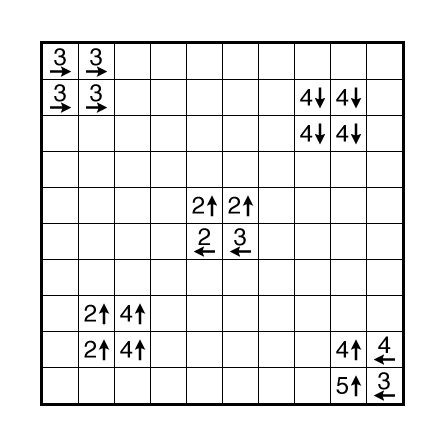
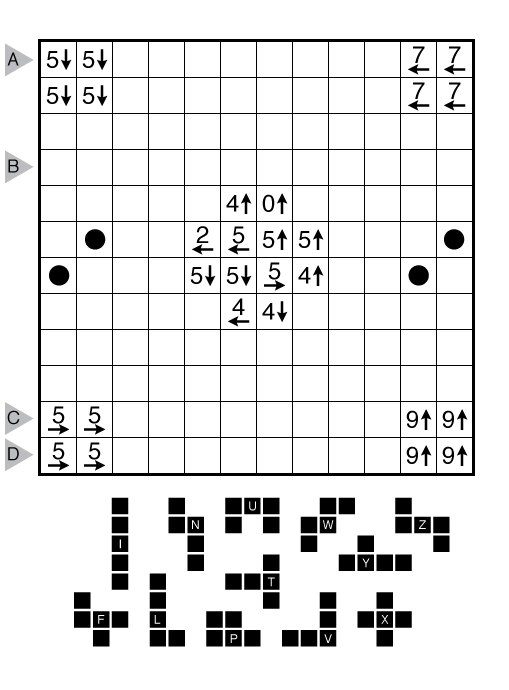
Statue Park (Yajisan-Kazusan) by Jamie Hargrove

Yajisan Kazusan by Jamie Hargrove

PDF

or solve online (using our beta test of Penpa-Edit tools)

Theme: Clue Symmetry & Logic

Author/Opus: This is the 6th puzzle from guest contributor Jamie Hargrove.

Rules: Place each of the twelve pentominoes into the grid once, with rotations and reflections allowed. No two pentominoes can overlap or be orthogonally adjacent, and all cells not occupied by the pentominoes must be orthogonally connected. The black circles indicate some cells that must be covered by pentominoes. Some numbers and arrows are also given in the grid. For all numbers that are not covered by a pentomino, the clues give the exact count of shaded cells in the given direction. A shaded over clue may or may not be true.

Answer String: Enter the length in cells of each of the shaded segments from left to right for the marked rows, starting at the top. Separate each row’s entry from the next with a comma.

Time Standards (highlight to view): Grandmaster = 10:30, Master = 17:15, Expert = 34:30

Solution: PDF

Note: Follow this link for other Statue Park Puzzles and this link for other less common Shading puzzles including Yajisan Kazusan puzzles.

Yajisan Kazusan (No 2×2) by Jamie Hargrove

Yajisan Kazusan by Jamie Hargrove

PDF

or solve online (using our beta test of Penpa-Edit tools).

Theme: No 2×2 White Blocks

Author/Opus: This is the 5th puzzle from guest contributor Jamie Hargrove.

Rules: Shade some cells black so that all unshaded number and arrow clues indicate the exact count of shaded cells in the given direction. Shaded cells cannot share an edge, and all white cells must remain connected as part of a single contiguous group. It is allowed to shade over some of the numbered cells; a shaded over clue may or may not be true. Also, as an extra rule from standard Yajisan Kazusan, there cannot be any fully unshaded 2×2 cell blocks in the grid.

Answer String: For each row from top to bottom, enter the number of shaded cells as a single string.

Time Standards (highlight to view): Grandmaster = 5:00, Master = 12:00, Expert = 24:00

Solution: PDF

Note: Follow this link for other less common Shading puzzles.

Nurikabe (Yajisan-Kazusan) by Jamie Hargrove

Nurikabe by Jamie Hargrove

PDF

or solve online (using our beta test of Penpa-Edit tools)

Theme: Clue Symmetry & Logic

Author/Opus: This is the 4th puzzle from guest contributor Jamie Hargrove.

Rules: Variation of Nurikabe. Some of the given island clues are actually part of the ocean and must be shaded over. (All other Nurikabe rules still apply, including all islands contain exactly one clue number equal to the area of the island.)

Answer String: Enter the length in cells of each of the black segments (the unnumbered, connected “ocean”) from left to right for the marked rows. Enter both digits for any two-digit number. Separate each row’s entry from the next with a comma.

Time Standards (highlight to view): Grandmaster = 3:30, Master = 8:15, Expert = 16:30

Solution: Solution: PDF; a solution video is available here.

Note: Follow this link for other classic Nurikabe. If you are new to this puzzle type, here are our easiest Nurikabes to get started on.

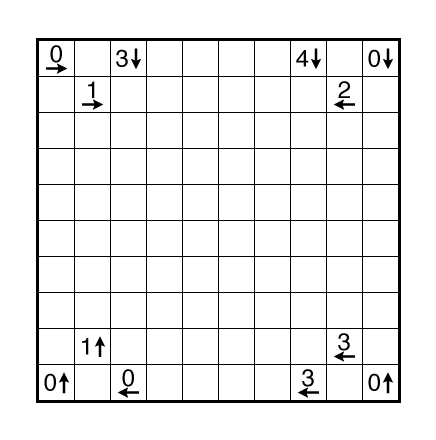
Yajisan Kazusan by Jamie Hargrove

Yajisan Kazusan by Jamie Hargrove

PDF

or solve online (using our beta test of Penpa-Edit tools).

Theme: 2×2 Clue Blocks

Author/Opus: This is the 3rd puzzle from guest contributor Jamie Hargrove.

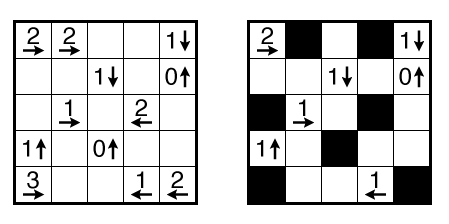
Rules: Shade some cells black so that all unshaded number and arrow clues indicate the exact count of shaded cells in the given direction. Shaded cells cannot share an edge, and all white cells must remain connected as part of a single contiguous group. It is allowed to shade over some of the numbered cells; a shaded over clue may or may not be true.

Also, see this example:

Yajisan Kazusan by Thomas Snyder

Answer String: For each row from top to bottom, enter the number of shaded cells as a single string. For the example, the answer is “20212”.

Time Standards (highlight to view): Grandmaster = 4:00, Master = 5:15, Expert = 10:30

Solution: PDF

Note: Follow this link for other less common Shading puzzles.

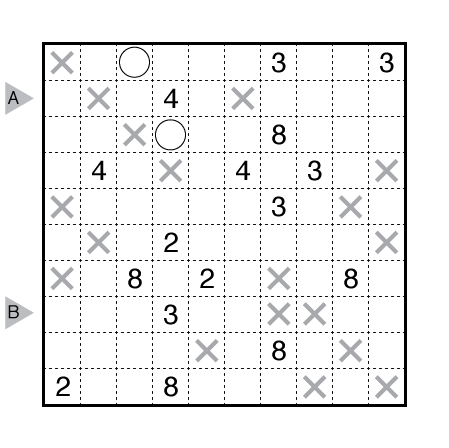
Snake Pit X by Takeya Saikachi

Snake Pit by Takeya Saikachi

PDF

or solve online (using our beta test of Penpa-Edit tools; use tab to alternate between a composite mode for line/edge drawing and a number entry mode.)

Theme: Clue Symmetry & Logic

Author/Opus: This is the 1st puzzle from guest contributor Takeya Saikachi.

Rules: Divide the grid along the boundary lines so that every cell belongs to a snake. A snake is a one-cell-wide path at least two cells long that does not touch itself, not even diagonally. Circled cells must be at one of the ends of a snake. A snake may contain one circled cell, two circled cells, or no circled cells at all. Numbered cells must be part of a snake with a length of exactly that number of cells. A snake may contain one number, multiple identical numbers, or no numbers at all. Two snakes of the same length cannot touch each other horizontally or vertically. [+ new rule] Cells with an X cannot be an end of a snake.

Also see this example:

Snake Pit

Answer String: For each cell in the marked rows/columns, enter the length of the snake it belongs to. Enter just the last digit for any two-digit number. This example has the key “33553,44664”.

Time Standards (highlight to view): Grandmaster = 5:00, Master = 10:30, Expert = 21:00

Solution: PDF

Note: Follow these link for other Fillomino or Snake puzzles.

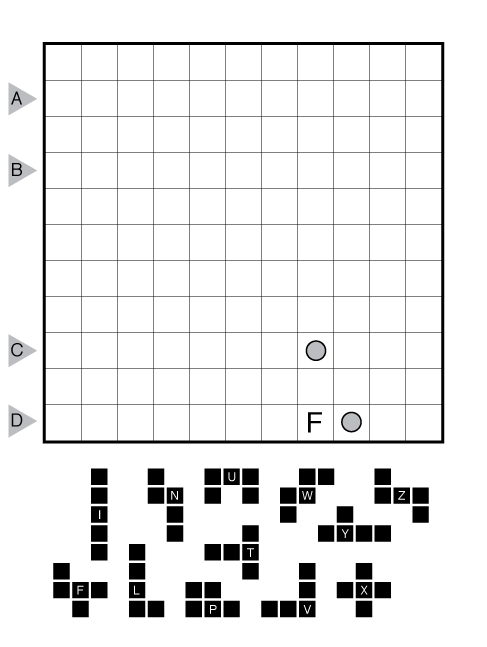
Pentosnake by Nikolai Beluhov

Pentosnake by Nikolai Beluhov

PDF

or solve online (using our beta test of Penpa-Edit tools using a composite mode where left click inside cell shades square, left click + drag draws line segment, right click inside cell adds dot, and right click on cell edge adds an x.)

Theme: One Letter Clue

Author/Opus: This is the 3rd puzzle from guest contributor Nikolai Beluhov.

Rules: Draw a snake (a 1 cell-wide path) in the grid whose head and tail are given by circled cells. The snake can touch itself diagonally, but cannot touch itself orthogonally. All cells that are not part of the snake must be part of a pentomino (i.e., an orthogonally connected group of five cells). These unused pentominoes cannot touch orthogonally but can touch diagonally. A letter in a cell represents the pentomino shape that the cell belongs to. Pentomino shapes can be repeated in the grid, and can also be rotated and reflected. (Lettered cells cannot be used by the snake.)

Answer String: Enter the number of cells in each of the snake segments from left to right for the marked rows, starting at the top. Separate each row’s entry with a comma.

Time Standards (highlight to view): Grandmaster = 4:45, Master = 7:15, Expert = 14:30

Solution: PDF; a solution video is available here.

Note: Follow this link for other Snake puzzles.

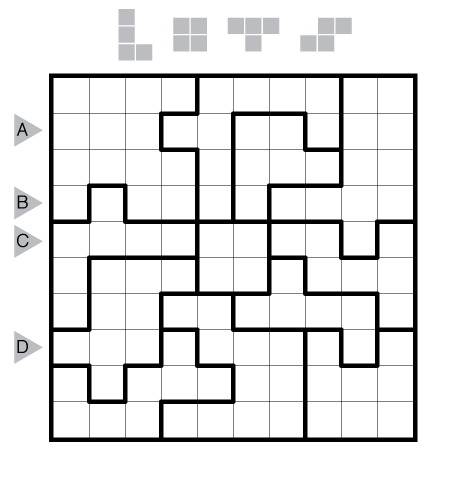
LOTS by Bryce Herdt

LOTS by Bryce Herdt

PDF

or solve online (using our beta test of Penpa-Edit tools)

Theme: Logical

Author/Opus: This is the 9th puzzle from guest contributor Bryce Herdt.

Rules: [Variation of LITS]. Shade exactly four connected cells in each outlined region, to form an L, O, T, or S tetromino, so that the following conditions are true:
(1) All shaded cells are connected with each other;
(2) No 1×4 group of cells can be entirely shaded black;
(3) When two tetrominoes in adjacent regions share an edge, they must not be of the same type (L, O, T, or S), regardless of rotations or reflections.

Answer String: Enter the length in cells of each of the shaded segments from left to right for the marked rows, starting at the top. Separate each row’s entry from the next with a comma.

Time Standards (highlight to view): Grandmaster = 3:30, Master = 5:15, Expert = 10:30

Solution: PDF

Note: Follow this link for more variations of LITS and this link for classic LITS. If you are new to this puzzle type, here are our easiest LITS to get started on.