Aqre by Eric Fox

Aqre by Eric Fox

PDF

or solve online (using our beta test of Penpa-Edit tools; use tab to shift between shading mode and the composite Yajilin mode where left click marks cells, right click marks dots in cells or X’s on edges, left click+drag draws lines.)

Theme: S

Author/Opus: This is the 9th puzzle from guest contributor Eric Fox.

Rules: Standard Aqre rules: Shade some cells so that all shaded cells form one connected group. Regions with numbers must contain the indicated count of shaded cells, and it is allowed to shade over the numbered cells. There may not exist a run of four or more consecutive shaded or unshaded cells horizontally or vertically anywhere in the grid. (Note: with this puzzle, we have updated our default formatting for Aqre to use smaller digits to not interfere as much with solver notation that may be used in those squares. The fundamental rules of the puzzle are unchanged.)

See also this example:

Aqre Example by Serkan Yürekli

Difficulty: 1.5 stars

Time Standards (highlight to view): Grandmaster = 1:00, Master = 1:45, Expert = 3:30

Solution: PDF and solving video.

Note: Follow this link for more Aqre puzzles. If you are new to this puzzle type, here are our easiest Aqre to get started on. More Aqre puzzles are in Shading Variety Collection by Prasanna Seshadri.

Masyu by Tom Collyer

Masyu by Tom Collyer

PDF

or solve online (using our beta test of Penpa-Edit tools in linex mode where left click+drag draws lines and right click marks X’s)

Author/Opus: This is the 49th puzzle from our contributing puzzlemaster Tom Collyer.

Rules: Standard Masyu rules.

Difficulty: 1 star

Time Standards (highlight to view): Grandmaster = 0:35, Master = 1:00, Expert = 2:00

Solution: PDF and solving video.

Note: Follow this link for classic Masyu and this link for Masyu variations. If you are new to this puzzle type, here are our easiest Masyu to get started on. More Masyu puzzles can be found in The Art of Puzzles and in our beginner-friendly book Logic Puzzles 101.

Japanese Sums by Sam Cappleman-Lynes

Japanese Sums by Sam Cappleman-Lynes

PDF

or solve online (using our beta test of Penpa-Edit tools; use tab to shift between number entry and shading modes.)

Theme: Why was 6 Afraid of 7?

Author/Opus: This is the 10th puzzle from guest contributor Sam Cappleman-Lynes.

Rules: Place the numbers in the indicated range (1-8) in some of the cells so that no number is repeated in any row or column. Numbers on the outside of the grid indicate the sums of adjacent number groups in that row or column, in order. Each sum is separated by at least one unused cell. A ? can represent any sum of 1 or larger.

Japanese Sums Example

Difficulty: 4.5 stars

Time Standards (highlight to view): Grandmaster = 12:00, Master = 20:00, Expert = 40:00

Solution: PDF and solving video.

Note: Follow this link for other Japanese Sums puzzles.

Japanese Sums by Prasanna Seshadri

Japanese Sums by Prasanna Seshadri

PDF

or solve online (using our beta test of Penpa-Edit tools; use tab to shift between number entry and shading modes.)

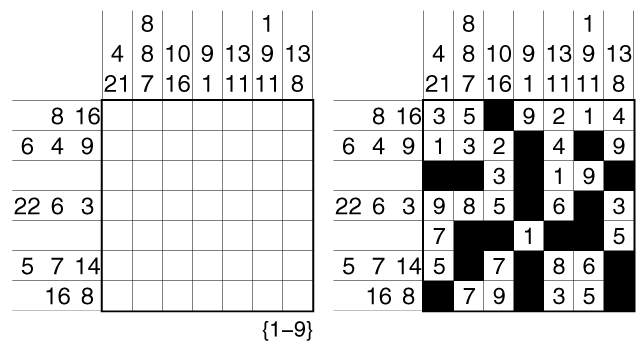
Theme: Twenty20 Vision

Author/Opus: This is the 238th puzzle from our contributing puzzlemaster Prasanna Seshadri.

Rules: Place the numbers in the indicated range (1-9) in some of the cells so that no number is repeated in any row or column. Numbers on the outside of the grid indicate the sums of adjacent number groups in that row or column, in order. Each sum is separated by at least one unused cell. The adjacent question marks (??) show two-digit numbers, not two groups)

Japanese Sums Example

Difficulty: 3.5 stars

Time Standards (highlight to view): Grandmaster = 6:00, Master = 9:15, Expert = 18:30

Solution: PDF and solving video.

Note: Follow this link for other Japanese Sums puzzles.

Japanese Sums by Ashish Kumar

Japanese Sums by Ashish Kumar

PDF

or solve online (using our beta test of Penpa-Edit tools; use tab to shift between number entry and shading modes.)

Theme: Doubles

Author/Opus: This is the 96th puzzle from our contributing puzzlemaster Ashish Kumar.

Rules: Place the numbers in the indicated range (1-6) in some of the cells so that no number is repeated in any row or column. Numbers on the outside of the grid indicate the sums of adjacent number groups in that row or column, in order. Each sum is separated by at least one unused cell.

Japanese Sums Example

Difficulty: 3.5 stars

Time Standards (highlight to view): Grandmaster = 4:30, Master = 8:15, Expert = 16:30

Solution: PDF and solving video.

Note: Follow this link for other Japanese Sums puzzles.

Japanese Sums by Thomas Snyder

Japanese Sums by Thomas Snyder

PDF

or solve online (using our beta test of Penpa-Edit tools; use tab to shift between number entry and shading modes.)

Theme: Common Denominations

Author/Opus: This is the 415th puzzle from Thomas Snyder, aka Dr. Sudoku.

Rules: Place the numbers in the indicated range (1-6) in some of the cells so that no number is repeated in any row or column. Numbers on the outside of the grid indicate the sums of adjacent number groups in that row or column, in order. Each sum is separated by at least one unused cell.

Japanese Sums Example

Difficulty: 2.5 stars

Time Standards (highlight to view): Grandmaster = 2:30, Master = 4:00, Expert = 8:00

Solution: PDF and solving video.

Note: Follow this link for other Japanese Sums puzzles.

Japanese Sums by JinHoo Ahn

Japanese Sums by JinHoo Ahn

PDF

or solve online (using our beta test of Penpa-Edit tools; use tab to shift between number entry and shading modes.)

Theme: High Five

Author/Opus: This is the 50th puzzle from our contributing puzzlemaster JinHoo Ahn.

Rules: Place the numbers in the indicated range (1-5) in some of the cells so that no number is repeated in any row or column. Numbers on the outside of the grid indicate the sums of adjacent number groups in that row or column, in order. Each sum is separated by at least one unused cell. A ? can represent any sum of 1 or larger.

Japanese Sums Example

Difficulty: 1 star

Time Standards (highlight to view): Grandmaster = 0:40, Master = 1:00, Expert = 2:00

Solution: PDF and solving video.

Note: Follow this link for other Japanese Sums puzzles.

Balance Loop by wormsofcan

Balance Loop by wormsofcan

PDF

or solve online (using our beta test of Penpa-Edit tools in linex mode where left click+drag draws lines and right click marks X’s)

Theme: Antisymmetry

Author/Opus: This is the 7th puzzle from guest contributor wormsofcan.

Rules: (Standard Balance Loop rules.) Draw a single, non-intersecting loop that passes through all circled cells. All white circles must have equal segment lengths on both sides of the circle before turning. All black circles must have unequal segment lengths on both sides of the circle before turning. Numbers indicate the sum of the segment lengths on both sides of the circle.

Also, see this example:

Balance Loop by Prasanna Seshadri

Difficulty: 3 stars

Time Standards (highlight to view): Grandmaster = 2:30, Master = 4:45, Expert = 9:30

Solution: PDF and solving video.

Note: Follow this link for other Balance Loop puzzles. If you are new to this puzzle type, here are our easiest Balance Loop Puzzles to get started on. More Balance Loops can be found in our beginner-friendly collection Intro to GMPuzzles by Serkan Yürekli and in Balance Loop by Prasanna Seshadri and Murat Can Tonta.

Balance Loop by Murat Can Tonta

Balance Loop by Murat Can Tonta

PDF

or solve online (using our beta test of Penpa-Edit tools in linex mode where left click+drag draws lines and right click marks X’s)

Theme: Incompatibility

Author/Opus: This is the 229th puzzle from our contributing puzzlemaster Murat Can Tonta.

Rules: (Standard Balance Loop rules.) Draw a single, non-intersecting loop that passes through all circled cells. All white circles must have equal segment lengths on both sides of the circle before turning. All black circles must have unequal segment lengths on both sides of the circle before turning. Numbers indicate the sum of the segment lengths on both sides of the circle.

Also, see this example:

Balance Loop by Prasanna Seshadri

Difficulty: 2.5 stars

Time Standards (highlight to view): Grandmaster = 1:45, Master = 3:15, Expert = 6:30

Solution: PDF and solving video.

Note: Follow this link for other Balance Loop puzzles. If you are new to this puzzle type, here are our easiest Balance Loop Puzzles to get started on. More Balance Loops can be found in our beginner-friendly collection Intro to GMPuzzles by Serkan Yürekli and in Balance Loop by Prasanna Seshadri and Murat Can Tonta.

Balance Loop by Grant Fikes

Balance Loop by Grant Fikes

PDF

or solve online (using our beta test of Penpa-Edit tools in linex mode where left click+drag draws lines and right click marks X’s)

Theme: Fours and Sixes

Author/Opus: This is the 379th puzzle from our contributing puzzlemaster Grant Fikes.

Rules: (Standard Balance Loop rules.) Draw a single, non-intersecting loop that passes through all circled cells. All white circles must have equal segment lengths on both sides of the circle before turning. All black circles must have unequal segment lengths on both sides of the circle before turning. Numbers indicate the sum of the segment lengths on both sides of the circle.

Also, see this example:

Balance Loop by Prasanna Seshadri

Difficulty: 2 stars

Time Standards (highlight to view): Grandmaster = 1:45, Master = 2:45, Expert = 5:30

Solution: PDF and solving video.

Note: Follow this link for other Balance Loop puzzles. If you are new to this puzzle type, here are our easiest Balance Loop Puzzles to get started on. More Balance Loops can be found in our beginner-friendly collection Intro to GMPuzzles by Serkan Yürekli and in Balance Loop by Prasanna Seshadri and Murat Can Tonta.